Briefing Document: Surface Modification Category Intelligence Audit (August 2026)
This report by Brandyard provides a comprehensive category intelligence audit of the surface modification market, focusing specifically on plasma and wet process technologies. It identifies a massive structural visibility gap, noting that industry incumbents are losing significant search and AI answer engine traffic to trade publications and research aggregators.
Executive Summary
https://brandyard.net/series/vol1-surface-modification
The surface modification category—encompassing atmospheric plasma, vacuum plasma, dielectric barrier discharge (DBD), and wet process cleaning—is currently experiencing a significant structural failure in digital visibility. Despite serving high-growth end markets like semiconductor packaging (54B) and medical device coatings (15.6B), the category is underperforming across Google search and AI answer engines.
Key findings from the August 2026 audit include:
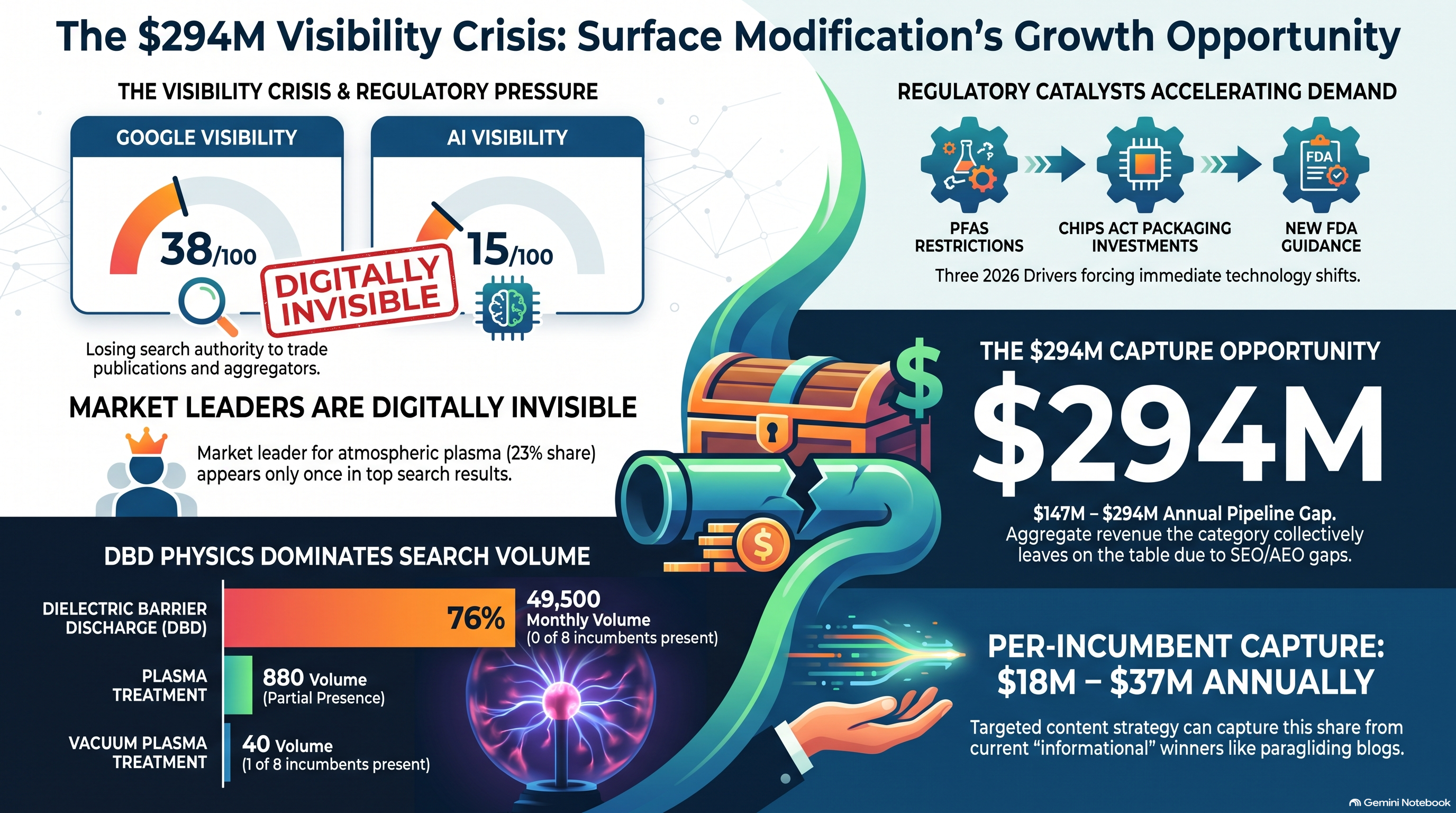
- The Visibility Crisis: The category aggregate Google Visibility Score is 38/100, while the AI Visibility Score is a critical 15/100.
- The Economic Toll: This visibility deficit results in a "Category Pipeline Gap" estimated between $147M and $294M annually.
- Market Leadership Disconnect: Market share does not correlate with search authority. For instance, Nordson MARCH (23% market share) is nearly invisible on primary "STAR" keywords, whereas Plasmatreat (19% share) is the only incumbent with consistent top-10 rankings.
- Regulatory Tailwinds: 2026 represents a pivotal moment due to converging regulatory catalysts, including PFAS restrictions in six U.S. states, CHIPS Act advanced packaging investments, and updated FDA biocompatibility guidance.
Market Context and Strategic Catalysts
The global equipment market for surface modification is valued at 400M–560M, with a CAGR of 5–7%. However, its strategic value is far higher, acting as a critical enabler for downstream sectors growing at double-digit rates.
2026 Regulatory Convergence
Three primary catalysts are driving immediate demand for plasma-based surface preparation:
- PFAS Restrictions: Effective in 2026 across Maine, Minnesota, Colorado, Vermont, Washington, and Connecticut, these restrictions phase out solvent-based wet cleaning in 15 industrial sectors, positioning plasma as the primary substitute.
- CHIPS Act Spending: TSMC’s $100B U.S. commitment and its 2026 Arizona packaging plant are driving demand for chiplet and hybrid-bonding technologies that require plasma-treated interconnects.
- FDA Guidance: The April 2026 draft guidance on Chemical Analysis for Biocompatibility Assessment (expanding ISO 10993-18:2020) makes plasma activation the preferred preparation method for implantable devices.
The Visibility Gap: Google vs. AI Answer Engines
The audit reveals that search visibility is being captured by trade publications and market-research aggregators rather than the equipment manufacturers themselves.
Search Engine Research Pages (SERP) Performance
- Structural Deficit: Only one of eight named incumbents (Plasmatreat) consistently appears in the top-10 for primary keywords.
- Invisible Leaders: Two incumbents (Zestron and Technic) are entirely absent from primary keyword SERPs. Nordson MARCH appears only once, at position 14, across three major keywords.
- The "Deep Third" Problem: Incumbents fight over narrow product-specific terms but leave the "buyer questions" (which convert to pipeline) uncovered. These are currently captured by publications like Semiconductor Digest and SMT Today.
AI Answer Engine (AEO) Performance
The AI Visibility Score of 15/100 indicates a "category-embarrassing" failure.
- Authority Vacuum: AI queries for vacuum plasma vendors currently surface content from unrelated sources, such as a paragliding blog and a credit union blog.
- Uncontested Queries: 25% of tested prompts—including those with high commercial intent—returned zero incumbent presence across Perplexity, ChatGPT, Google AI Overviews, and Copilot.
Competitive Landscape: The Five-Zone Map
The audit categorizes incumbents based on their content maturity and search behavior rather than just revenue:
Zone Description Incumbents
Zone 1 Content Maturity Leaders (200+ articles) Plasmatreat GmbH
Zone 2 Legacy Authority (Underinvested Content) Nordson MARCH, PVA TePla
Zone 3 Product-Catalog Only Diener Electronic
Zone 4 Chemistry Adjacency (No Plasma Content) Kyzen, Zestron, Inventec, Technic
Zone 5 Emerging Asia Challengers Keylink
Key Insight: Pricing across the category is universally opaque. All eight incumbents utilize a "contact for quote" model, creating a barrier for buyers and a content opportunity for any vendor willing to publish indicative cost frameworks.
Keyword Intelligence and Content Gaps
The measurable keyword universe consists of 65,150 monthly searches, dominated by "Dielectric Barrier Discharge" (DBD) at 76% of total volume.
STAR Keywords (Primary Opportunities)
- Dielectric Barrier Discharge (49,500/mo): High volume, growing, currently dominated by academic/physics sources.
- Vacuum Plasma Treatment (40/mo): Growing, high commercial intent.
- Plasma Surface Treatment (170/mo): Growing, informational intent.
- Atmospheric Plasma Cleaning (40/mo): Growing, highly contested.
Identified Content Gaps
The audit identifies three critical areas where buyer questions remain unanswered by incumbents:
- Atmospheric vs. Vacuum Decision Frameworks: No comprehensive guide exists to help buyers choose between these two primary technologies.
- Power Supply Selection (AC vs. Pulsed DC): A technical gap exists for specification-stage buyers.
- Total Cost of Ownership (TCO) & ROI: No incumbents provide transparent models for comparing in-house plasma equipment against contract cleaning services.
Economic Implications: The Pipeline Gap
The category collectively leaves a massive amount of pipeline on the table due to intermediation by trade journals and market research firms.
Category Pipeline Gap Scenarios (9-Month Effective Year): | Scenario | DBD Commercial Share | Annual Pipeline Value | 9-Month Gap | | :--- | :--- | :--- | :--- | | Conservative | 20% | ~196M | 147M | | Base Case | 30% | ~224M | 168M | | Optimistic | 50% | ~392M | 294M |
Note: In the Base Case, the gap represents approximately $21M in lost pipeline per incumbent.
Strategic Roadmap and E-E-A-T
To capture this gap, the audit recommends a shift toward "named-expert" content to satisfy Google’s E-E-A-T (Experience, Expertise, Authoritativeness, Trustworthiness) requirements.
6-Month Content Strategy
The proposed 18-article calendar is designed to build a topically coherent knowledge graph:
- Months 1-2: Establish pillars for DBD, Atmospheric vs. Vacuum frameworks, and TCO models.
- Months 3-4: Focus on regulatory adjacencies (PFAS-free, Chiplet packaging) and specific verticals (Medical device surface activation).
- Months 5-6: Consolidate semiconductor wafer cleaning and safety compliance (SEMI S2/S8) content.
Conclusion
The surface modification category is in a "structural authority vacuum." Because no single vendor currently anchors the category with dominant expert content, an aggressive 90-to-180-day content deployment can displace non-industry aggregators and secure a leading position in both Google and AI answer engine results.
Analyst-grade category intelligence for technical B2B markets. Free.
Seven volumes mapping where technical categories are visible, where they are invisible, and what that gap is worth — each anchored in live Paxelo data and written from thirty years inside these markets.
Surface Modification: Plasma and Wet Process Technologies →Author

Stephen Sowinski — Founder & CEO, Brandyard
Stephen is the founder of Brandyard, a B2B marketing practice that builds custom AI tools and content systems for industrial and SaaS operators. Over a 30-year career, he has held marketing leadership roles at Nordson Plasma Systems, Interstate Plastics, Interstate Advanced Materials, Plastic Machining Company, and a natural gas filtration distributor. He is the author of the forthcoming book The Cluster Method: How to Build Content That Ranks on Google and Gets Cited by AI, and the architect of Paxelo, a production AI content engine running on the Abacus platform. He is a member of the International Association of Plastics Distributors (IAPD).
More about Stephen → brandyard.net/about