Brandyard Category Intelligence Series·VOLUME 1·SEPTEMBER 2026
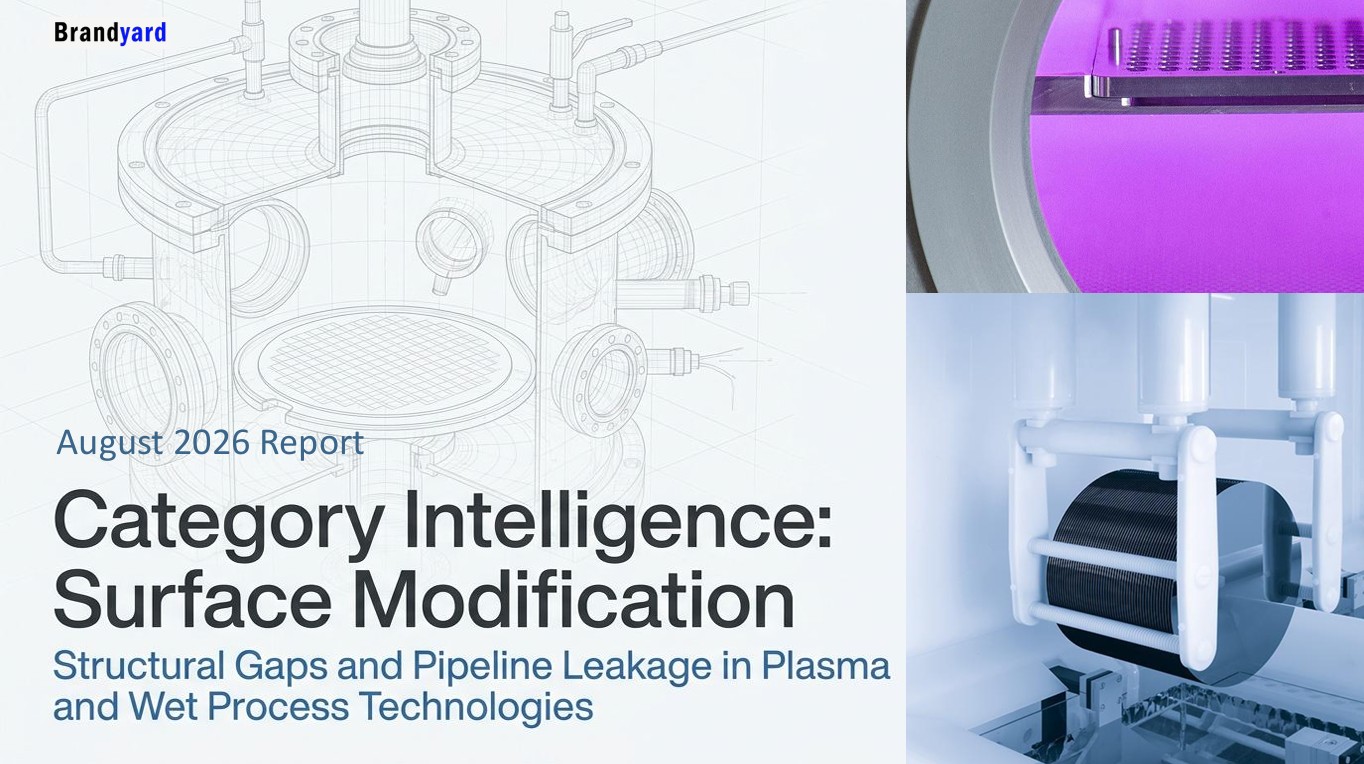
Surface Modification: Plasma and Wet Process Technologies
A category intelligence report on plasma and wet process surface modification technologies across semiconductor packaging, medical devices, and automotive electronics.
Brandyard
Category Intelligence Series
1
Vol. 1
Surface Modification: Plasma and Wet Process Technologies
38/100
Search visibility
15/100
AI visibility
$147M - $294M
Pipeline gap
45/100
Authority
What Volume 1 covers
The category that finishes every surface before it performs.
Surface modification — plasma treatment, wet chemical process, and the adjacent cleaning and activation steps — is the quiet gate every high-reliability assembly passes through. It decides whether an adhesive bonds, whether a coating adheres, and whether a device survives its qualification. It is also, in content terms, one of the most under-served technical categories in the market.
Volume 1 maps that category end to end: how buyers search for it, how the incumbents position around it, where the search and AI-engine visibility actually sits, and what the resulting pipeline gap is worth. It applies all five analytical frameworks and the full seventeen-section structure that anchors every volume in the series.
Named incumbents mapped
Primary end markets
What's inside
Seventeen sections, in the same order, every volume.
Executive Summary
The category thesis, headline scores, and the single most important finding on one page.
Category Definition & Scope
What the category covers, where the technology boundaries sit, and what is deliberately excluded.
Market Landscape & Sizing
Addressable market, segment breakdown, and the growth vectors across the primary end markets.
End-Market Analysis
Demand drivers in each served end market and how buying behavior differs across them.
Incumbent Mapping
The named players, their positioning, and where each concentrates its content and commercial energy.
Competitive Content Audit
Coverage depth by incumbent, the topical clusters they own, and where the whitespace sits.
Search Visibility Gap
Where category buyers search and where the current leaders fail to appear.
AI Engine Visibility Gap
How answer engines surface — or omit — category expertise, and which sources they cite instead.
Pipeline Opportunity Model
The revenue at stake in the visibility gap, with every assumption behind the range shown.
Buyer Intent & Journey
The questions technical buyers ask at each stage and the content that actually meets them.
Keyword & Topic Architecture
The hub-and-spoke cluster map that would establish category authority.
Regulatory & Standards Context
The compliance, qualification, and standards signals that shape how the category buys.
Technology & Process Deep Dive
The core process trade-offs, framed for a commercial rather than a bench audience.
Authority Scorecard
The four-score methodology and how the category rates against it today.
Content Gap Priorities
The ranked list of assets that would close the visibility gap fastest.
Strategic Recommendations
The publishing plan, sequencing, and resourcing required to capture the pipeline.
Methodology & Sources
Data provenance, the scoring rubric in full, and the editorial standards applied.
Why Volume 1 starts the series
The baseline every later volume references.
Surface modification sits upstream of almost everything else the series covers. Get the surface wrong and the die attach fails, the underfill delaminates, the coating lifts. Starting here establishes the vocabulary, the scoring rubric, and the category logic that the rest of the series builds on.
It is the first move in a connected arc. Volume 2 (Die Attach and Underfill Adhesives) and Volume 3 (Precision Fluid Dispensing) pick up directly where surface preparation leaves off, while Volume 6 (Medical Device Coatings) and Volume 7 (Semiconductor Wet Process) return to the same surface chemistry from the two most demanding end markets in the set.
Read in sequence, the volumes compound — exactly the way authority does when a category is covered as a connected cluster rather than a stack of disconnected posts.
Get Volume 1 now, and the rest as they publish.
One form. Volume 1 arrives immediately; every subsequent volume lands in your inbox the day it publishes.

About the author
Stephen Sowinski
Founder, Brandyard · Creator of Paxelo
Thirty years of C-suite marketing leadership across energy, semiconductor, PCB manufacturing, and advanced materials — and roughly $800M in revenue driven for technical B2B companies.
Two ways forward
Ready to apply this to your own category?
Book a 20-minute strategic call
A direct conversation about your category, your visibility gap, and where the pipeline is hiding. No pitch deck.
Learn more about the Personal Audit
A category intelligence audit built for your domain — the same methodology behind the series, applied to your business.